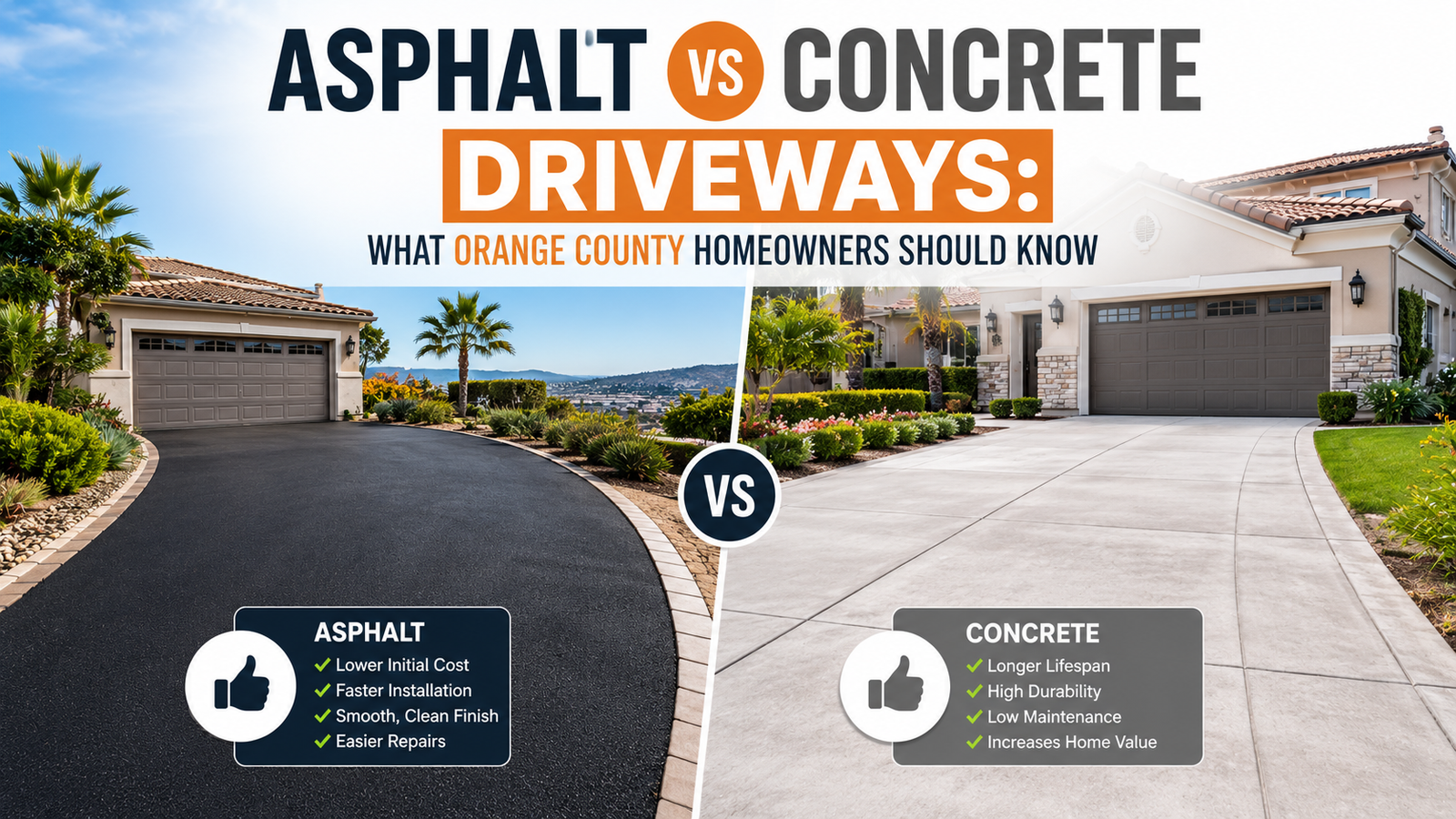
When it comes time to install or replace a driveway, Asphalt vs Concrete Driveways Orange County are the two most common materials homeowners consider. Both are durable, widely used, and capable of providing decades of service when properly installed and maintained, but they differ in meaningful ways, from appearance and material composition to how they perform under Orange County’s specific climate conditions. Understanding these differences helps homeowners make a more informed choice based on what matters most for their particular property and priorities.
What Each Material Is Made Of
Asphalt, sometimes called blacktop, is composed of aggregate, crushed stone and sand, bound together with bitumen, a petroleum-based binder that gives asphalt its dark black color and flexible characteristics. Concrete, by contrast, uses cement combined with water as its binder, mixed with a similar aggregate base of sand and crushed stone. This difference in binder is what accounts for many of the practical distinctions between the two materials, from color and flexibility to how each one responds to temperature changes over time.
How Each Material Performs in Orange County’s Climate
Climate is one of the more important factors to weigh when choosing between asphalt and concrete, and Orange County’s warm, sun-intensive conditions affect each material somewhat differently.
Asphalt’s dark color absorbs more heat than concrete’s lighter surface, which means it can soften slightly during extended periods of intense heat. This characteristic actually gives asphalt an advantage in one respect, its flexibility allows it to handle minor ground movement and temperature-driven expansion and contraction without cracking as readily as a more rigid material might. Concrete, being lighter in color, reflects more sunlight and tends to stay cooler to the touch, but its rigidity means it can be more prone to visible cracking if the ground beneath it shifts, even slightly, over time.
Comparing Installation and Curing Time
The installation process for both materials follows a similar general sequence, excavation, base preparation, and material application, but the timelines differ once the surface material is down. Asphalt cures relatively quickly, generally becoming ready for vehicle traffic within a few days of installation. Concrete requires a considerably longer curing period, often around a week, before it’s ready to handle the weight of a vehicle, due to the chemical curing process concrete undergoes as the cement hydrates and hardens.
Appearance and Design Flexibility
Asphalt is limited primarily to its natural dark black or dark gray appearance, though some specialized coloring and sealing options exist. Concrete offers considerably more design flexibility, since it can be stained, stamped with decorative patterns, or finished in a variety of textures and colors. Homeowners prioritizing a specific aesthetic, particularly one that complements a home’s architectural style or matches other hardscaping elements on the property, often find concrete’s design versatility to be a meaningful advantage.
Maintenance Requirements Over Time
Ongoing maintenance needs differ somewhat between the two materials. Asphalt generally requires more frequent routine maintenance, including periodic sealcoating every few years to protect against UV exposure and moisture, along with prompt crack sealing as needed. Concrete requires less frequent routine maintenance, since it isn’t as susceptible to UV-driven oxidation the way asphalt is, though when concrete does crack, the repair is often more visually noticeable, since patched sections can be difficult to blend seamlessly with the surrounding surface.
Comparing Long-Term Durability
Both materials, when properly installed and maintained, offer a long service life, though there are some differences worth noting. Asphalt driveways typically last in the range of 15 to 30 years with proper care. Concrete driveways often last longer, sometimes 30 to 40 years or more, thanks to its greater rigidity and resistance to the kind of surface wear that gradually affects asphalt. That said, asphalt’s flexibility can be an advantage in situations involving shifting or unstable soil, since it’s generally less prone to the kind of visible cracking that can occur when a rigid concrete slab settles unevenly.
Common Questions About Asphalt and Concrete Driveways
Which material is easier to repair?
Asphalt is generally considered easier and less noticeable to repair. Cracks and potholes can often be patched with materials that blend reasonably well with the surrounding surface, and resurfacing an entire asphalt driveway is a relatively straightforward process. Concrete repairs, by contrast, tend to be more visible, since it’s difficult to perfectly match new concrete to an existing slab that has weathered and aged over time.
Does one material handle heavy vehicles better than the other?
Concrete generally has a higher load-bearing capacity due to its rigidity, making it a common choice for driveways that need to regularly accommodate heavier vehicles like RVs or larger trucks. Asphalt can be engineered with additional thickness to handle heavier loads as well, though this typically needs to be planned for during the initial installation.
How does each material affect a home’s resale value?
Both materials are widely accepted and generally viewed as reasonable, standard choices by potential buyers. Some buyers may have a preference based on regional norms or personal taste, but neither material is typically viewed as a drawback compared to the other, provided the driveway is in good condition.
Can asphalt or concrete be installed over an existing driveway?
In some cases, yes, particularly for asphalt, which can sometimes be installed as an overlay over an existing surface that’s still structurally sound. Concrete replacement more commonly involves removing the existing slab first, though this depends on the specific condition of what’s already there. A site assessment is generally the best way to determine which approach makes sense for a given property.
Considering Long-Term Property Plans
A driveway decision is also worth weighing against longer-term plans for the property. Homeowners planning to stay in a home for many years may prioritize the material that best matches their maintenance preferences and climate performance expectations over the full span of that ownership. Those anticipating a sale in the nearer term might instead weigh which material is more common and expected in their specific neighborhood, since matching local norms can sometimes simplify the decision without meaningfully affecting resale outcomes either way.
Noise, Heat, and Everyday Comfort Considerations
Beyond structural and maintenance considerations, a few everyday comfort factors are worth weighing as well. Asphalt tends to absorb road noise more effectively than concrete, resulting in a slightly quieter surface underfoot and under tires, a detail that matters more for larger properties or those near living spaces than for a typical single-family driveway. On the temperature side, asphalt’s dark surface absorbs significantly more heat than concrete’s lighter color, which can make it noticeably hotter to the touch during peak summer afternoons in Orange County, something worth considering for households with children or pets who spend time on the driveway barefoot or with bare paws.
Environmental Considerations Worth Understanding
Both materials carry their own environmental considerations. Asphalt production and installation can release volatile organic compounds during the heating and application process, though modern paving practices have reduced these emissions considerably compared to past decades. Concrete production is associated with notable carbon emissions during cement manufacturing, though concrete itself can often be recycled at the end of its service life. Neither material has a clearly superior environmental profile across every metric, and homeowners with strong environmental priorities may want to discuss specific product options and installation practices with their contractor, since formulations and techniques continue to evolve.
How Soil Conditions Can Influence the Right Choice
The composition and stability of the soil beneath a driveway is another factor worth considering when choosing between materials. Asphalt’s flexibility gives it an advantage on properties with soil that’s prone to minor shifting or seasonal expansion, since the material can accommodate small movements without cracking as readily as a rigid surface would. Concrete, while more prone to visible cracking under significant ground movement, offers superior resistance to surface indentation and rutting, making it a strong choice for properties with stable, well-draining soil and a need for maximum load-bearing capacity. A basic assessment of a property’s soil conditions during the planning stage can help clarify which material is likely to perform better over the long term.
Edge Conditions and Everyday Wear
The way each material handles edges and transition points, where a driveway meets a garage apron, sidewalk, or street, is another practical difference worth understanding. Asphalt edges, particularly along unsupported sides of a driveway, can be somewhat more prone to crumbling over time if they aren’t properly compacted during installation or if vehicles regularly drive close to the edge. Concrete edges tend to hold their shape more consistently, though when concrete does crack near an edge or joint, the damage is often more visually obvious than a comparable issue in asphalt. Discussing edge detailing and support during the planning phase, regardless of which material is chosen, helps minimize this type of wear over the life of the driveway.
Weighing the Decision for Your Property
Ultimately, the choice between asphalt and concrete often comes down to a combination of climate considerations, maintenance preferences, aesthetic goals, and how the driveway will be used day to day. Both materials have a long track record of reliable performance when properly installed, and understanding how each one specifically performs under Orange County’s warm, sun-intensive conditions helps homeowners weigh the tradeoffs more clearly. For those comparing asphalt vs concrete driveways in Orange County, considering both the immediate installation factors and the longer-term maintenance rhythm each material requires offers a well-rounded starting point for making the right choice for a specific property.